



Dear reader, the flagellation fetish did not drop out of the sky fully formed in leather and good lighting. It crawled slowly out of temples, monasteries, classrooms, courtrooms, and underground print shops. Let’s explore the strange, horny, very human history of why a smack can mean salvation in one century and “text me when you’re home” in another.
Long before the flagellation fetish had a name, hitting with intent had a meaning. In ancient Rome, the festival of Lupercalia involved priests running around with strips of goat hide, striking people they encountered. Some accounts describe women deliberately presenting themselves to be struck because it was associated with fertility.
Over in Sparta, there was a whipping ritual tied to the sanctuary of Artemis Orthia. It has been described as an intense rite that later writers remembered as bloody and extreme, the kind of thing that makes modern people squint and ask what exactly everyone thought they were proving.
The point is not “the ancients were into it like we are.” The point is that physical punishment and endurance were already being used as symbolism for fertility, courage, purification, and belonging.
Christian tradition includes long-running ideas about mortifying the flesh. Sometimes that meant wearing hair shirts, fasting, or engaging in self-denial. Sometimes it meant a literal whip.
Then the 13th and 14th centuries turned the volume up. During waves of crisis, including the Black Death, public movements of penitents practiced self-flagellation in processions, believing it would ward off disaster or earn mercy. Authorities often suppressed or condemned these movements, but history can get dark fast.
In Medieval Europe, pain was used as proof of sincerity. Not erotic, but absolutely intimate. The body as evidence.
Here’s where things get deliciously weird.
By the 1600s, you can find printed medical discussions arguing that whipping could stimulate the body. One notorious example is Johann Heinrich Meibom’s treatise on the use of flogging in “medical and venereal” contexts, which circulated in Latin and later in English translation. The publication history is messy across editions and reprints, but the core fact stands: people were putting this idea in print, with a straight face, as “medicine.”
Around the same era, Christian Franz Paullini’s Flagellum Salutis collected stories about “healing through blows,” and it’s frequently misdated in casual retellings. Better documentation places it in the late 17th century, with later editions and reprints continuing the legend.
This is a crucial bridge for the flagellation fetish: once a culture starts describing whipping as invigorating or restorative, it becomes easier for erotic imagination to borrow the same script.
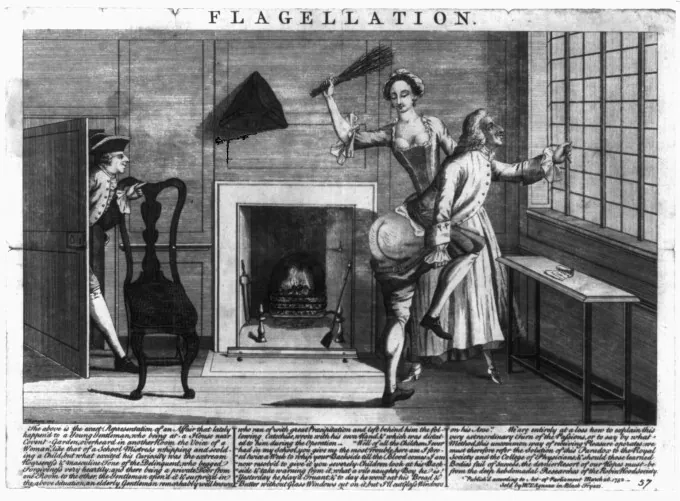
Image Source: The Telegraph
If the flagellation fetish has a “literary glow-up,” it’s Victorian England, where sexual hypocrisy basically ran on coal.
Underground erotica leaned hard into chastisement themes. Works and periodicals didn’t just include a stray spanking scene. Some were devoted to flagellation as a central engine of desire and narrative. Titles like The Romance of Chastisement (1866) and The Convent School (1876) put the theme front and center, while The Pearl (1879 to 1880) famously ran serial content that included a flagellation-focused thread.
This is also where the vibe becomes very recognizable: “discipline,” “instruction,” “schoolroom,” “correction,” and that intoxicating tension between shame and attention. It’s not a coincidence. Corporal punishment was woven into institutions at the time, so the erotic imagination didn’t need to invent the props. It just needed to twist the meaning.
By the late 19th century, sexologists were cataloging desires like a strange new wildlife preserve. Krafft-Ebing’s Psychopathia Sexualis (first published in 1886) discusses flagellation as a sensory stimulant and folds it into broader attempts to classify “deviations.”
And here’s a myth-buster that matters: people often credit Krafft-Ebing with “algolagnia,” but the term is commonly traced to Albert von Schrenck-Notzing in the early 1890s, introduced to talk about lust linked to pain. The vocabulary evolves, and the labels fight each other for dominance.
This era didn’t invent the flagellation fetish. It named it, moralized it, and turned it into a “case.”

Image Source: The Book Merchant
Then comes the moment your group chat will recognize.
John Willie’s magazine Bizarre is regularly cited as a foundational fetish periodical of the mid-20th century, associated with bondage art, fetish fashion, and a stylized dominance fantasy universe. It ran from the late 1940s into the late 1950s and helped crystallize a shareable, collectible fetish look.
In the American scene, Leonard Burtman’s Exotique carried the torch with an emphasis on fetish fashion and female-dominant fantasy framing, often discussed as a descendant of Bizarre. This is the flagellation fetish going visual, portable, and collectible. The whip stops being only a metaphor. It becomes an icon.
Modern kink culture did something radical. It took practices historically linked to punishment and said: not without consent, not without care, not without clarity.
That’s the pivot. The same gesture can mean trauma in one context and trust in another. The difference is not the tool. It’s the agreement.
So, if history makes flagellation feel spooky, that’s fair. It has worn a lot of ugly uniforms. But the contemporary reframe is exactly what makes it worth discussing as adult culture, not just scandal: negotiated power can be art. It can be intimacy. It can be a chosen story instead of an imposed one.
The flagellation fetish survives every era because it plugs into something ancient: the body as a canvas for meaning. Sometimes that meaning was public virtue. Sometimes it was private rebellion. Sometimes it was clandestine erotica slipped into a gentleman’s pocket like a sinful little secret.
Today, it can be simpler and hotter: consensual impact, controlled intensity, and the kind of trust that makes the room go quiet in the best way.










© 2026 NSFW.Army. All Rights Reserved


