Piper Rockelle is a star in her own right. Long before the days of the Bop House, she was racking up millions of YouTube views as a child creator.
But times of change, and she's now an adult, and that means moving on to more adult ventures. She opted to go down the path of adult content creation and wanted to ensure her official OnlyFans launch was a viral sensation. It turned out to be just that, but not for the right reasons.
The screenshot Piper Rockelle posted of her first-hour earnings appears to have been modified, as the person editing the image left a stray $ at the end of the number, suggesting the photo had been digitally manipulated.
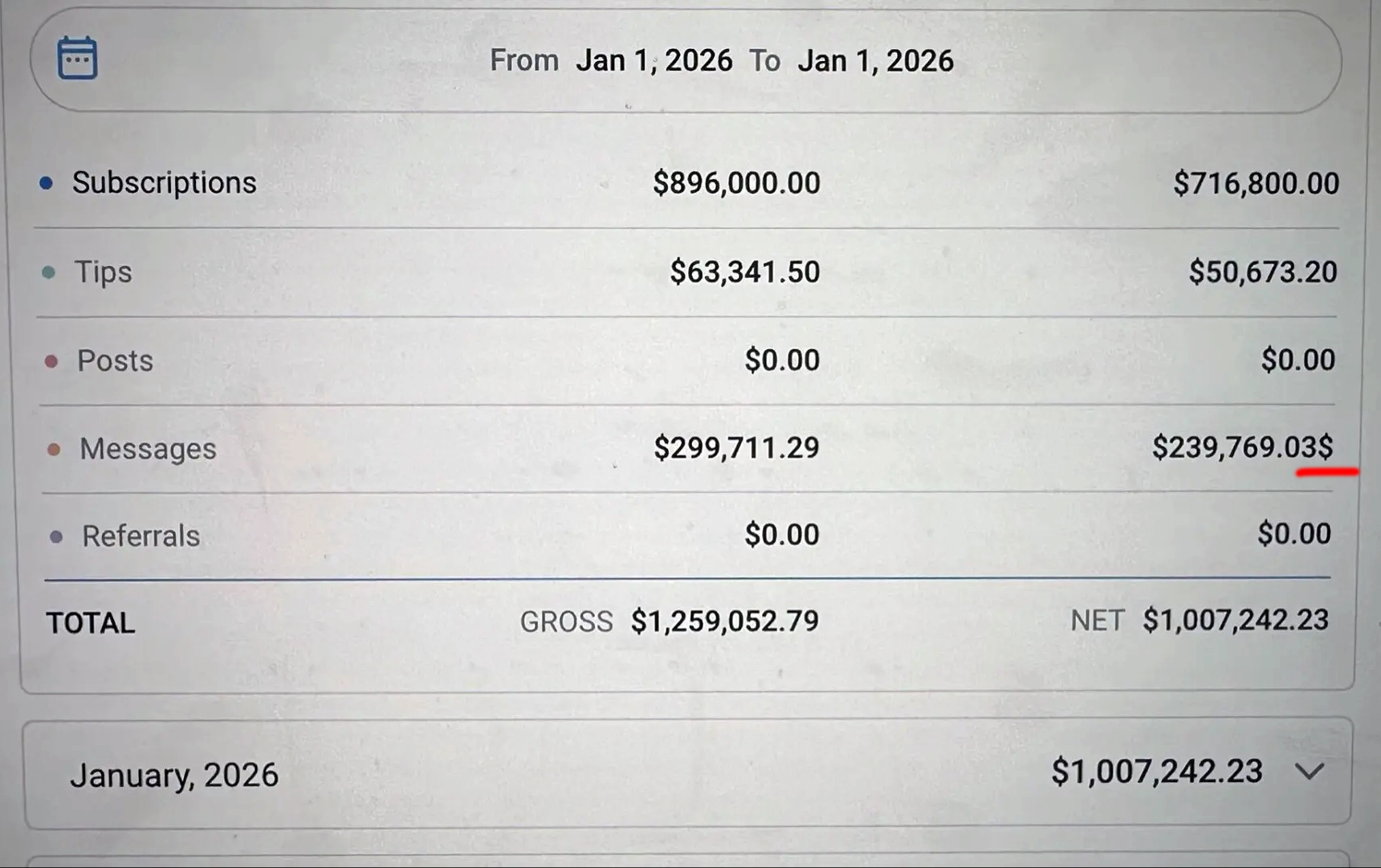
Using a figure like $2,927,313.00 on the first day is not about money — it’s about manufacturing inevitability.
When a creator like Piper Rockelle makes a claim like that, the message is: “This is already a phenomenon. You’re not deciding whether it’s big, only whether you’ll be part of it.”
That reframes the audience’s role from judge to follower, and when you are trying to be a viral social media sensation, this is exactly what you want.

Using this marketing tactic short-circuits skepticism by creating “fait accompli” success. People are much more skeptical of “Check out my new page” than “This already broke the internet.
A giant first-day number eliminates the evaluation phase and skips straight to acceptance. The brain assumes:
“If millions of dollars already flowed in, the market has already decided.”
This is called post-hoc legitimacy; success is treated as proof of merit.
Post-hoc legitimacy is when apparent success is used as evidence of value, causing people to accept something as legitimate without ever evaluating it themselves.
Doing something like this weaponizes social proof at maximum intensity. Social proof scales non-linearly.
At extreme numbers, people stop asking “Is this good?” and start asking: “What am I missing?” That question is psychologically dangerous; it creates self-doubt, which drives impulsive action.
The oddly specific figure — $2,927,313.00 — is not random. Specific numbers feel more truthful than round ones and suggest internal data or leaks. They have also been proven to bypass the “marketing exaggeration” filter.
Your brain reads: “No one would invent that exact number unless it were real.”
(They absolutely would — and do.)
Even being exposed as fake can still work. Here’s the cynical brilliance ... if the numbers are questioned or exposed as fake, the creator still gains:
For many viewers, the takeaway isn’t: “This was fake.” It’s: “She made so much money people are arguing about it.”
Controversy preserves the core signal: relevance. The sheer volume of TikTok videos and Instagram reels that have been creating talk about Piper Rockelle's fake sales figures probably doubled her income, if not more. Everyone is talking about it, and in the game of marketing, that's what you want.
As Taylor Swift put it, “If it's the first week of my album release and you're saying my name or the album title, you're helping. I have a lot of respect for people's subjective opinions on art. I'm not the art police. Everybody is allowed to feel how they want.”
OnlyFans marketing and music marketing aren't all that different. What you want is people talking about you, and her photoshop mishap did just that.
OnlyFans has three key properties that make this tactic lethal:
The claim isn’t: “You’ll like the content.” It’s: “You’ll be connected to someone who is winning.”
Using this tactic implies that Piper Rockelle, or more accurately, the people managing her image, understand how attention functions as a currency. They recognize that in a crowded digital economy, momentum matters more than accuracy, and that the appearance of success can generate real success faster than any careful explanation ever could. By leading with an overwhelming claim, they bypass skepticism and force the audience into a reactive position, where the only remaining question is whether to join in or be left behind.
This approach reflects a clear understanding that belief almost always comes before verification. Facts can be checked later, if at all; what matters in the moment is creating a narrative that feels already settled.
A willingness to lean on exaggerated or fabricated signals of success shows a comfort with manipulating crowd psychology rather than appealing to individual judgment. This is not naïveté or youthful exaggeration.
It is calculated myth-making, designed to manufacture legitimacy first and let reality struggle to catch up afterward.

This is not just a story about Piper Rockelle or an OnlyFans launch. It is a case study in how modern legitimacy is manufactured. Numbers no longer follow success; they create it.
Audiences no longer evaluate; they react. And in a system built on visibility rather than verification, the line between fact and fiction matters far less than whether people are watching.
I'm not saying manufacturing drama like the Bop house is known to do is right or wrong, but there are sound and proven marketing principles behind it. As the saying goes, don't hate the player, hate the game.












© 2026 NSFW.Army. All Rights Reserved